Japan launches MMX mission to bring back samples from Mars' moon Phobos
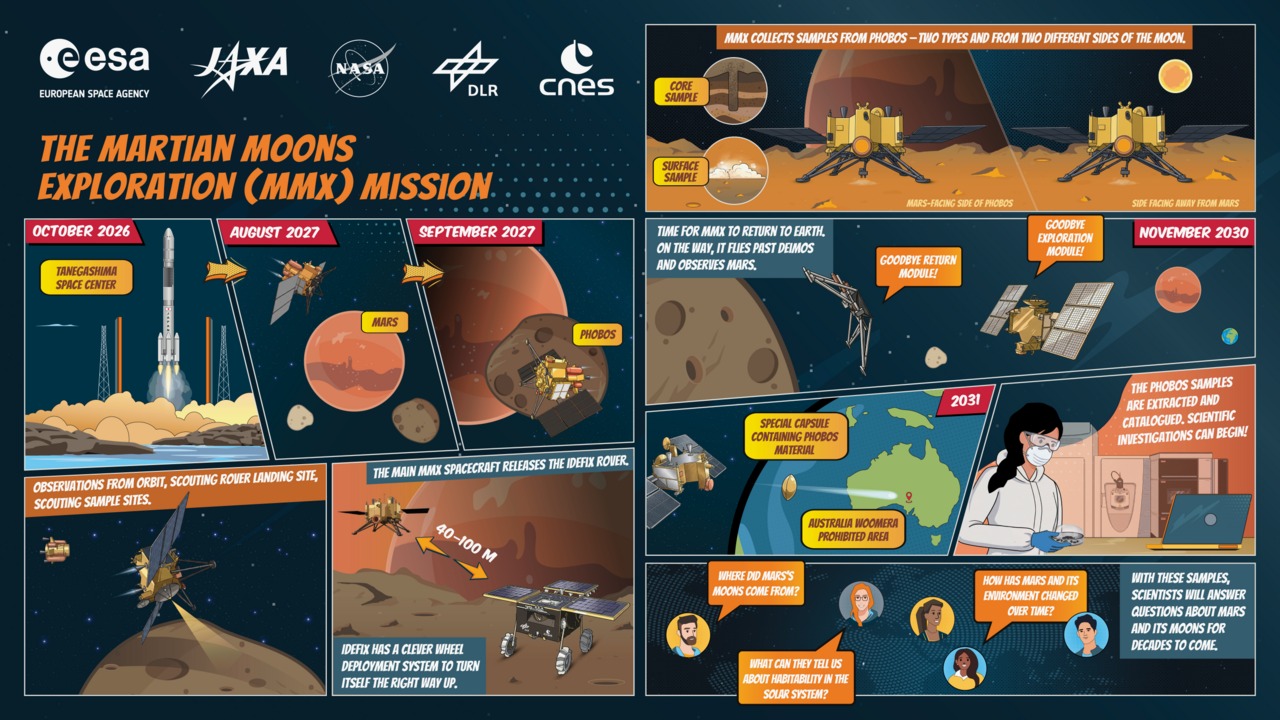
Japan has launched a spacecraft to collect samples from Phobos, a moon of Mars. The H3 rocket lifted off at 3:41 PM ET Monday, Space.com and CNN reported. The craft is due to reach Mars in August 2027 and return samples in 2031.
Japan's space agency, JAXA, has launched its Martian Moons eXploration mission, known as MMX, which aims to bring back the first samples from Phobos, a moon of Mars, Space.com and CNN reported. An H3 rocket lifted off from Tanegashima Space Center at 3:41 PM ET on Monday, which was 4:41 AM Tuesday in Japan, matching the launch time JAXA had set.
It was the 10th flight of the H3 rocket, Space.com reported. The rocket's upper stage fired a second time for about six minutes and 25 seconds to send MMX toward Mars, the site reported. The spacecraft was then released right on schedule, roughly 71 minutes after liftoff, to loud cheers in mission control, Space.com reported. JAXA's flight plan had set the release for about 71 minutes after launch.
MMX is due to reach Mars in August 2027, Space.com reported. A small rover built by France and Germany, called IDEFIX, is set to land on Phobos in late 2028 or early 2029, Space.com reported. The main spacecraft will then touch down at two sites and collect more than 10 grams of material, which is set to return to Earth in 2031, CNN reported.
Scientists hope the samples will show how Phobos and the smaller moon, Deimos, formed. "This is kind of like one of the major outstanding mysteries of solar system formation," Daniel Glavin of NASA's Goddard Space Flight Center, a participating scientist on the mission, said, CNN reported.
One idea is that the moons formed from debris after a large object hit Mars. Another is that they are asteroids pulled in by its gravity. "None of our data fit either hypothesis correctly," said Abigail Fraeman of NASA's Jet Propulsion Laboratory, who is also a participating scientist on MMX, CNN reported. The samples may also hold tiny bits of Mars itself, she said.
After the first landing, the search for the second site will take several more months, Tomohiro Usui, a JAXA scientist, said in an interview with CNN. "Landing operations are very risky," he said.
The mission carries instruments from NASA and other space agencies, The Associated Press reported earlier. A separate NASA and European plan to return samples from Mars itself has been effectively canceled after its funding was halted, the BBC reported.
What we know: MMX launched on time Monday, and Space.com reported that the spacecraft was released on schedule.
What we don't: Whether the spacecraft will land safely on Phobos and bring its samples home.
Where outlets agree Space.com and CNN report that Japan's MMX mission lifted off on an H3 rocket at 3:41 PM ET Monday to collect samples from Phobos.
Where they differ The cited reports agree on the key facts so far.