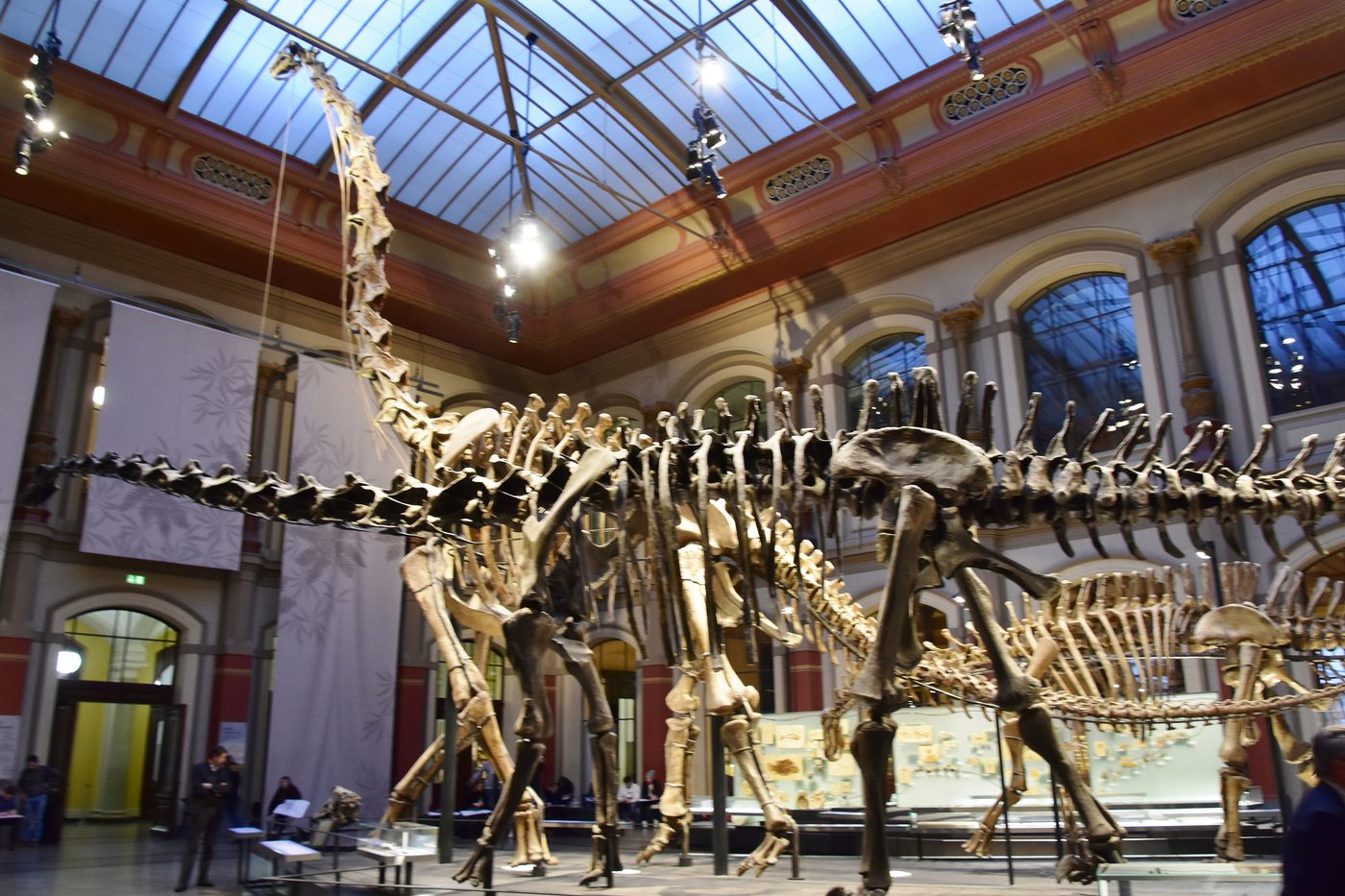
Scientists report possible remnants of dinosaur blood
According to NPR, scientists say they found possible signs of dinosaur blood in a bone that is 115 million years old. Kliti Grice found heme, a part of blood, in canals in the bone. An outside expert was not fully convinced.
According to NPR, scientists say they have found some of the strongest evidence yet of dinosaur blood, though not a vial of liquid blood. Organic geochemist Kliti Grice of Curtin University in Perth, Australia, studied a 115-million-year-old bone with unusually good preservation. Looking at vascular canals where blood vessels would have run, she said, "you can see these red blood cell-like structures." NPR’s Nate Rott interviewed Grice for the report.
Grice said the sample went through about 30 analytical techniques. The team found evidence of heme, part of hemoglobin, the iron-containing molecule that helps transport oxygen and gives blood its red color. In a study published in the Proceedings of the National Academy of Sciences, Grice says this is the first time heme has been detected in a dinosaur fossil in a vascular canal. "So I’m quietly confident that these may be red blood cells," she said.
Outside scientists are more cautious. Sandra Siljestrom, an organic geochemist at RISE Research Institutes in Sweden, said in the NPR interview, "It’s tantalizing, but maybe I’m not completely convinced." She said some of the chemistry is "very convincing" and "very well done," but that the data is a little noisy because any signal from individual, ancient cells would be very small. Other scientists have questioned the shape of the possible cells. They say the structures are not the right size and lack a nucleus, a feature of bird and crocodile red blood cells.
Grice argues that scientists do not really know what a mineralized red blood cell should look like, and she agrees that the morphology alone is not that convincing. "I think that’s the weakest part of the paper, but you have to collectively look at the evidence," she said, pointing to the chemistry, the location of the structures, and their concentration. She hopes the same method can be used on other old bones. That, she said, would test the finding further.
NPR presents the result as possible remnants, not a settled discovery of dinosaur blood. The cited report does not include a comment from PNAS beyond the published paper, and it notes that the structures resemble red blood cells rather than being proven to be red blood cells.
Only NPR has reported this so far; NewsHabit hasn't seen independent confirmation.
What we know: NPR reports that Grice’s team detected heme in canals of a 115-million-year-old dinosaur bone. An outside expert called the finding tantalizing but was not fully convinced.
What we don't know: Only NPR has reported this so far; NewsHabit hasn't seen independent confirmation.
Where outlets agree NPR reports that researchers detected heme in a 115-million-year-old dinosaur bone and present it as possible evidence of red blood cells.
Where they differ Outside expert Sandra Siljestrom called the work tantalizing but was not completely convinced, and other scientists have questioned the shape of the possible cells.